Monday, February 25, 2013

The Purple Scarf Saga

I won't bore you with all the details, but sometime in January a lady asked me to make her a scarf. I thought she wanted one of my short crocheted snuggies. I can make one in about 3 hours, easily. But she wanted a particular color purple, to match her coat. I told her, "You choose and buy the yarn, and I'll make it. I'll knock a few dollars off the price, since you're buying the yarn." I told her to buy two skeins. And off she went.
She came back with this lovely and slightly expensive bamboo yarn. Worsted weight, but smooth and thin and soft.
Then she told me what she really wanted. She really wanted a  L  O  N  G  scarf. She likes to double her scarves, making a loop on one end and the two tails on the other end. Then she wraps the scarf around her neck, and sticks the two ends through the loop. It falls to her waist. She presented me with the measurements.

She wanted a scarf 87" long by 10" wide. In the confusion of the moment and the business of the market, I agreed. I even knocked a few dollars off the price of a snuggie (that I can make in 3 hours), because she'd paid for the yarn. Sheesh. I'm insane. Oh, did I mention she wanted it knitted? A knitted scarf over 7 feet long. Yeah, I'll be working on that the Rest of My Natural Life.

It wasn't her fault. The lady knows nothing of knit or crochet. She didn't suggest the knit; I offered it because I thought she wanted a flatter, finer look. I did it to myself.

After one false start, and hunting for more yarn (two skeins does NOT make a 7 foot scarf), not finding said yarn, buying other worse yarn, doing and undoing, and knitting endlessly for four weeks, I finished the scarf yesterday:
Here's the second yarn she chose, because the first purple yarn was discontinued:
Red Heart Super Scratchy gives me the heebie-jeebies. But she thought the color of it might work with the other purple.
The scarf is rather wide.
 I wet it thoroughly and blocked it gently overnight on my ironing board. It's curling along the edges, of course. 

I did a row of single crochet on each end, to help it lie flat there. But if I do that along each long edge, it will only make it wider.
Now I need my lady friend to come over and examine it. Does she want it as it is? I imagine she'll want at least 6" of fringe on each end, which will help. I could double the scarf over, making it narrow, but it will feel a bit thick. The Red Heart is much bulkier than the Bamboo.  The Bamboo would double beautifully. It's a shame there was no more of it.

Well, regardless, it's over at last. I'm so happy to move on to other more creative projects. I realized this time that a yarn project for which I don't pick the yarn and I don't design the look, is no fun. I don't like being a knitting machine. In my next post, I'll show you what I've finished since yesterday ... a purse, and a pair of smittens  for myself!

Saturday, February 23, 2013

Why the Book? A Second-hand Life

I just read my friend Gretchen's post about a children's book, Blue Chameleon. As usual, Gretchen is astute, and she makes me ponder things. Her post asks several questions. Why do children's book authors introduce inappropriate topics to children of a certain age, like loneliness to a 3 year old? It's a good post; go read it.

Gretchen also asks why children's books teach colors. She says this: "I'd prefer to teach colors with a book like The Color Kittens -- not that anyone is in dire need of a book to learn about this aspect of every single item in his environment."

My jaw dropped. What an obvious thing. Why do we use books to teach about things that are so ubiquitous? Can we not point to red things, repeat the word "red," and get our point across to the child? Can we teach counting and numbers this way as well? How many other practical, daily things and ideas do we lean on books for, which we could teach to our children directly? Can't we just show them what shoes and chairs and hairbrushes actually are, instead of showing them pictures in books, of real things that lie all around them? Well?
"1 Is One," a number book by Tudor

Books are inherently representative. Nothing on the page is real except the paper and the ink. Is that why reading is such an a difficult and essential skill? It's the skill we use to teach this convoluted, representational, roundabout practice. Learn your letters, which have no real meaning. They parallel sounds we make, but on the page they are silent. Put the letters together to make words, but those merely stand for real objects and concepts. Read lots of words to grasp ideas that you could just look up from your book and see.

Isn't that a lot of work? Why do we do it?

As an aside, I'll mention that learning to read music is much the same, only more laborious. The process of learning that the symbols on the page represent sounds made on a torturous instrument, and rhythms one must learn to feel -- it's a miracle anyone learns to read music well.

But what about my question? Is reading a skill we want children to acquire, so that we can then teach them? Learn to read, we say, so that you can learn everything else, which is written in books. That's changing, you know. Lately a distinct shift has occurred in education that says, Don't read about it. Do it. Touch it. See it. The assumption is that the book is really an obstacle, something that stands between the child and truly experiencing counting blocks or touching a fish or seeing a dinosaur bone or visiting the ocean. Whole educational programs are now founded on manipulatives, on movement and kinesthetics, travel, nature, experiencing the education.
Montessori classroom -- lots of fun, but not a book in sight

Books do stand between us and the world. Dickinson said a book is like a boat that can take you anywhere, with so little effort or cost. Is that a good thing? Wouldn't it be better to go see the world instead? Is a book just a second-rate option? What do you think? Perhaps books stand between us and the world to protect us. How preferable is it to read about dangerous places, dangerous people, even dangerous science projects, rather than discover then first-hand? Is it better for a 3 year old to read about loneliness in a book, so he'll be ready when it visits him personally? I don't know.

In this way, I think perhaps computers have much in common with books. Certainly we use them to experience our world second-hand, more than we ever did with our reading.  I can take a college course, visit Ireland, hear a world-class pianist play Rachmaninoff, chat with a friend from across the world, and see my old childhood home in Virginia, without leaving my laptop. Even a book doesn't do that.

Why do we humans have such a penchant for symbol? For little letters to stand for an object? For many tiny black words to tell a life? If you find an answer, let me know.

Friday, February 22, 2013

Denial at Burger King

Last night, Adam, Julia, and I went to eat dinner at a local fast food place.
And that's very unusual. We don't do fast food. We don't particularly like the fare, and I don't like the prices. But we had three coupons, thanks to those naughty receipts from Dollar General. "$2.00 -- Get a Whopper Jr. and a Value Fries." So we went out in the cold to Burger King.

A sign in the window told me that a Whopper Jr.'s normal price was only $1.29, so I realized we weren't getting much of a deal. I wanted to add a milk shake to my dinner, as did Julia. We had to order and pay separately, to use the coupons. Adam took one look  at the situation and opted instead for a Whopper Combo Meal. Smart man.

The milk shake prices on their lit sign above the counter showed this: Small: $1.99, Medium: $2.49, Large: $2.99. I chose a medium and similarly instructed Julia. I chose strawberry; she opted for chocolate.

It was tiresome, but the cashier had to ring up my coupon meal separately from my shake. Sigh. I paid the $2.00+tax for the burger/fries. And then I paid $3.19 for the shake. I was flustered with all the cash and coupons flying about. Julia ordered the same, and she paid. 

And we waited. Thus, I had time to think of what I'd just paid. A shake that costs $2.49, ends up being $3.19 with tax?

So I asked the flurried, sweaty manager about the prices of her shakes. At first she looked at me as if I were just another stupid customer, taking up her time. But then she examined her cash register with its impenetrable computer software, and the lighted sign over her head. She swiveled back and forth. She furrowed her brow. I kept asking her, in a calm voice, about those prices, and why I'd just paid an extra dollar for my milkshakes. She wouldn't reply. She was stuck: she could not intervene with her cash register; it was smarter than she was. I mean that in a good way. The days are gone when a manager can simply take a dollar out of a register and hand it to you because he owes it to you. The machine is in charge.

I asked her, "What is the cost of a medium milkshake?" "$2.99" she replied, because her register had instructed her to.  "But the sign says $2.49," I added. "The sign is wrong," she said. "But the sign is what you're showing to the customers.

And then, she produced her solution. She reached up somehow, and turned that sign off. Yes, one-fourth of the Burger King price sign in Grantsboro, NC is black and vacant, so that customers will not know what they're paying for milkshakes.

What kind of solution is that? Which one is really correct? Why, the sign, of course. The register's prices were coded incorrectly. Some computer whiz is needed to fix that. But until then, everyone will be over-charged 50¢ for milkshakes. 

And she can pretend all is well, simply by turning off the sign. 

There's probably a sermon illustration, a political analogy, and an economic lesson, all rolled up in there somewhere. I sat, ate my indifferent dinner, and went home. What use is there in arguing with a woman who sees the world in such blind ways?

Next time, when there is a next time, we'll eat down the road at Hardees.

Wednesday, February 20, 2013

Eat Adventurously

Do you ever find that the best-tasting meals are the ones that you throw together somewhat haphazardly and creatively? It happened today. I was home alone for lunch. (I know that you mothers with children in the house will read that with a shake of the head. Your day will come.) I looked around in the kitchen and rejected the usual grilled cheese sandwich with store-bought bread and square processed cheese. I rejected the bowl of Campbell's over-salty tomato soup. And instead I made a salad.

Here, I should post a picture of my salad, but alas! It is eaten. And in my enthusiasm for it, I forgot you and your camera-dependent eyes. Let me describe it:  I began with leftover lettuce from last night's supper. I rinsed and spun it in the spinner that still sat in the dish dryer, so handy. I chose a pretty plate. I grabbed a whole tomato. Both the lettuce and tomato were reduced at the grocery, so I felt clever to be eating them so soon. Then, oh my! I would want a boiled egg on my salad, so I must begin that immediately. A farm-fresh brown egg went into water, was covered, and I turned again to my tomato. I prefer them diced, not wedged, in a salad.  Last night, Adam asked if I wanted any of the very leftover stinky cheese (some sort of soft brie/blue blend) on my salad, and I'd declined. It was a good cheese, creamy, not too strong. But now, alone in the kitchen? Feeling adventurous and creative? Sure, I said to myself. I'll have some.

I carved off about half of the cheese wedge, removed the thin rind, and crumbled it with my hands on the tomatoes. This was fun. I hoped it would be good, because if it's bad, it will be a strong bad. A decent bottle of poppyseed dressing sat on the bottom refrigerator shelf as well, also reduced and neglected. I dolloped it on the cheese and waited for my egg.  In my enthusiasm, and since waiting is tiresome, I grabbed a very old jar of sliced peaches from the deep recesses of the frig. It was hard to open because it was frozen shut! The syrupy liquid was also frozen around the four or five peach slices in the bottom of the jar. Well, if it's been frozen, they're probably not rotten, I thought, and emptied them into a bowl to accompany my salad.

Then the egg boiled. I let it sit, covered for five minutes, which was all the patience I possessed. It was too fresh to peel easily, in spite of adding salt (which our local egg men say solves this problem) and in spite of covering it immediately with ice water. However, sliding a silver spoon inside the shell, and pressing its bowl against the underside of the shell, is a fine way of scraping all the egg out, if you don't mind too much how it looks.

The salad was stupendous. The cheese lent a lovely flavor and texture to the other, blander items. Why don't I do this more often? I asked myself. I polished off the plate, the peaches, and a glass of grape juice, and was immensely satisfied. My mouth tasted good. I didn't brush my teeth for several hours, as the flavors of the poppyseed, tomato, and the blue cheese romanced each other on my palate.

It began with rejecting the ordinary, and grabbing the leftovers. Let's all have a more adventurous attitude toward our kitchens.

Julia's Still Life

Here's the still life that Julia painted this morning during art class. We're both very pleased with it.
During January she seemed a little 'off her game,' art-wise. I think the art competition she was in rattled her nerves.
Two of her pieces in that competition went on from the district level to the state level. I don't know when we'll hear about that.
These additional close-ups are just for those of you who like looking at watercolors. I think she did a good job with her shading and depth. The flower shapes are very nice too, especially the daffodils.

The two pieces that are at the state competition are an pencil sketch that she calls "Escher Hand." She didn't want to submit it in the first place, because it was incomplete (according to her). She's left-handed, so she could easily sketch her right hand like this.
And her zentangle, or zendoodle, or whatever it is:
It's always a mystery why judges choose as they do.

Tuesday, February 19, 2013

Welcome Home, Willows!

Do you remember the world travelers, Mole, Ratty, and Toad? The Willows Threesome is on its way home! Hooray!
In late fall, 2011, three wanderers arrived in our home. Remember? I blogged about their visit, about cookies and tea with them, how Julia and I colored in their traveling copy of The Wind in the Willows, put our stamp in their passport, and sent them on their way 'round the world.
They did go 'round the world -- England, France, then on to Australia and New Zealand, I believe. This week they arrive back where they began, at Pom Pom's house in Colorado. Home again, how nice! Pom Pom is planning a warm welcome for the weary three. I believe Badger will be waiting for them there. Badger is a serious homebody and did not participate in their wild adventures.
I just went looking for my copy of The Wind in the Willows by Grahame, and I'm sad to say I could not find it! It looked just like this:
Well, phooey. Don't know where it is. I might have given it away. This means I need a new copy. It might be time to make a purchase of some books online, yes?
In honor of Pom Pom's tea party, I decided to share some photos of this little tea set. It's not mine; it's Julia's. Her grandma gave it to her. It's about the most adorable one I've ever seen. Not complete, oh I wish! I blogged about it two years ago.
Here's the little tea pot.
And the tiny sugar bowl
One cup and three plates are all we have.
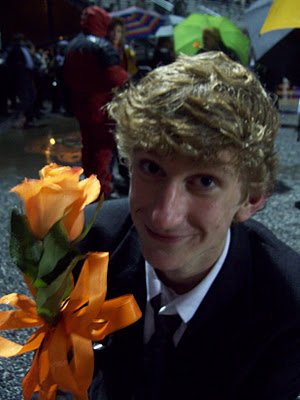
 And that dried rose blossom? It also came to me over a year ago, from Peter, when he knelt down and gave it to me with a sweet smile, during the last football game of his senior year. Awww, sweet. I keep things like that.
 This little plate/silver set is mine. I put the quarter there so you can see how small it is. I love it!
I'm looking forward to Pom Pom's welcoming tea party. I only wish I could be there in person to see those travelers again!

Monday, February 18, 2013

Thoughts on Standardized Testing

Ah, standardized tests. One of the predictable annoyances of American life. We all took them yearly in school. Remember the week of boredom? Sitting in the quiet, warm room, waiting for the other kids to finish erasing and coloring little bubbles? Watching the sun outside the window? It makes me nappy just thinking of it. None of us took it very seriously; it was an inconvenience. Nobody assumed it had much to do with real school, the things we learned everyday. There was a vague correlation, but who really cared?

Not any more. Public schools are all about EOG and EOC ("end of grade" and "end of class") tests. Everybody's teaching to the test because the tests are now important. Teachers jobs and salaries are tied to them. When I talk to public school kids, they love throwing around the testing terminology. It makes everyone feel important. We're taking tests! we say. Tests are a big deal!  That's the feeling I get. As a homeschooler, that can be intimidating. Homeschoolers might wonder, "How would my child do with all that hard testing? Would they even pass?"

Recently, some friends of mine got to find out. They live rather far away in a different state, and they've always homeschooled their many children. Their pack of school-aged children had never been tested. That's right -- never taken a standardized test. Not the CAT, the Stanford, Iowa Basic Skills, nor any of the other favorites. One year, one of the children was really fighting and struggling with math, so they decided (after much deliberation), to give him the year off math. I know for a fact that the mom, who does most of the teaching, has given thorough and organized thought to the course of education for the children. Both parents are very bright and well-educated. And although they aren't wealthy at all, the home is free from any drug or alcohol abuse or any of that stuff. All that to say, it's a safe, loving family, with a simple life style. Education isn't administered like medication. There's no teaching to a test. There is only teaching because learning is a wonder, is fun, and important. That's the mentality.

But ... will that mentality wash, when the kids are faced with standardized testing? Can kids who've never tested nor been prepped for testing, pass? Can a child who's skipped a year of math even hope to pass?

Well, we found out. They all took standardized tests, administered from the county schools by a kind lady. And after much fingernail biting on my part, I was thrilled to learn that all the children did fine. Just fine.

Which makes me wonder about those standardized tests that all the public school world seems to revolve around like a sun. It seems like a hoax, somehow. If homeschool kids who spend hours each day playing in the backyard, reading in their beds, and making apple pies can pass handily, why are the school kids laboring in boredom, day after day, "getting ready for the test"?  Why?

Last week I emailed my North Carolina testing company I've been using for five years. I buy an old CAT test for Julia for $40. I administer it at home each April. (I know! Horrors! A parent administering a test!) I time her, and I never cheat. Why would I cheat? What possible good would a false test result do me? But frankly, I'm weary of testing Julia. She doesn't need it.

Last year, in 7th grade, she scored 12.9 in "grade equivalency" for the entire opening battery (including reading, language skills and math), and 12.9 for spelling, science, and social studies as well. Of course, that does not mean I would place her in the 12th grade in some school (and in the 9th month, to boot!). It only means that the test indicates that she is performing in all those subjects as students in the 9th month of their senior year, would be performing. I do not say all this to brag on my child. I want to show the uselessness of such tests. I know well all the things that Julia still needs to learn. In 7th grade, she'd never started algebra, never had high school science at all. What in the world are they testing for, on these tests? I'm baffled.

Yet, the state of North Carolina declares that I must test her each year. Don't you think we all could agree at this point that she is one student who doesn't need any more testing? If I never did another scholastic thing with her (which would go against both our natures), she could enter college in a few years and do fine.

But thousands of homeschoolers agonize over whether they're doing enough. And thousands of public school kids think they're brilliant for taking such useless tests.  There's a growing movement for "opting out" of test taking.  How much time and money is being wasted on this test-inflation mentality? We've thrown so much money at a broken system. Now there's a call for universal pre-K from the White House. Really? Another program that will do more harm than good?

I wonder: If I opted out of testing, who in the state administration could successfully argue that Julia needs more testing? That it would do her one iota of good? Phooey. If I were more of a rebel, I'd consider it.